
Clusia care guides
Can Clusia survive a Florida freeze?
Clusia is not frost-proof, and a Florida address does not guarantee winter suitability. Confirm the species and local exposure before planting, especially inland and in North Florida.
· Clusia King Farms
Read hardiness information cautiously
Clusia cold tolerance is not a single temperature that separates guaranteed survival from certain death. Species identity, plant condition, duration of cold, wind, recent weather, and the actual exposure around the canopy all matter. UF/IFAS lists Clusia rosea for USDA zones 10B through 11; that is a regional suitability description, not a promise that an individual hedge tolerates every winter event. Do not transfer that listing automatically to plants sold as Clusia guttifera. A forecast from a nearby station may differ from the temperature in a low corner of the property. Use hardiness information to screen planting choices, then assess the site and seek local guidance rather than advertising a universal minimum temperature.
Map exposure before cold arrives
Identify which plants stand in open wind, low terrain, or containers and which occupy a sheltered courtyard. Buildings may alter exposure, but a nearby wall does not make a tropical planting freeze-proof. Newly installed plants and roots confined above ground deserve particular attention because their conditions differ from established roots in a broad soil bed. Keep a plant inventory and inspect supplies before a warning rather than improvising in the dark. If repeated winter injury is already a pattern, reconsider species selection and placement. Protective measures are temporary risk reduction, not a substitute for a suitable climate. Document which sections were injured in previous events to guide decisions about replacement and future planting locations.
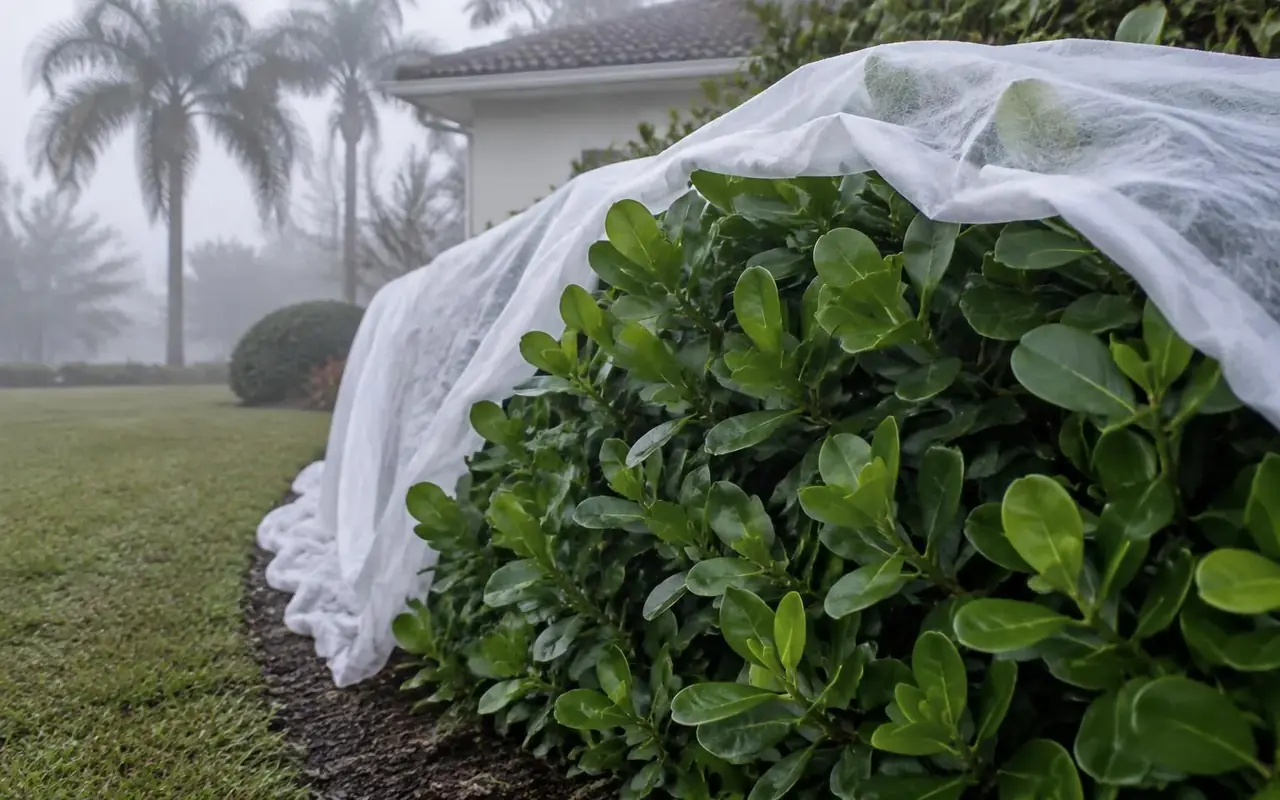
Use covers without creating new hazards
For plants small enough to protect, follow local Extension guidance on frost cloth and support it so that weight does not crush the canopy. A cover reaching the ground can help retain ground warmth; loose material over only the upper leaves offers a different level of protection. Secure edges against wind without strangling stems. Avoid direct contact between foliage and plastic, and remove or ventilate coverings as conditions warm so plants do not overheat. Move manageable containers to an appropriate sheltered location before the event if this can be done safely. Never introduce open flames, unsafe electrical equipment, or indoor heaters into improvised covers. No cover guarantees survival during prolonged or severe freezing conditions.
Do not confuse irrigation with guaranteed protection
Check moisture before the event and avoid allowing an already dry root ball to remain severely stressed, but do not saturate the bed as a reflex. A household sprinkler is not a dependable freeze-protection system. Professional irrigation protection requires suitable design, continuous operation under the right conditions, and specialized judgment; an unsuitable attempt can increase injury or create ice hazards. Do not promise that wet soil makes roots freeze-safe, especially in containers or exposed locations. Keep drainage functioning and avoid drastic fertilizer applications intended to prepare plants for cold. Any treatment should follow actual plant needs and applicable guidance. Forecast monitoring and realistic species selection are more reliable planning tools than improvised emergency watering rituals.
Assess recovery before removing living structure
Cold-damaged leaves may discolor or drop after the weather improves, and the full extent of injury may not be obvious immediately. Photograph the symptoms, record the event, and avoid declaring every leafless branch dead on the first warm afternoon. Delay major cosmetic pruning until the damage can be assessed and the immediate cold threat has passed, while addressing broken or hazardous material safely. Check moisture because reduced foliage changes water use; do not keep delivering a previous volume without inspection. Seek professional assessment if stems continue dying, the plant becomes unstable, or recovery is uncertain. There is no guaranteed recovery date. Repeated severe injury should prompt a planting decision rather than an indefinite cycle of emergency rescue.
Identify the plant before choosing a plan
Confirm the botanical name on the nursery label and ask the supplier to identify the actual stock. Clusia rosea and the small-leaved plant commonly sold as Clusia guttifera are not interchangeable names. UF/IFAS documents C. rosea as a tree reaching about 25–30 feet tall and 15–25 feet wide, with moderate growth. Those dimensions describe an unrestrained tree, not a promise about a regularly clipped hedge. The same publication lists USDA zones 10B–11, full sun to dappled shade, and high drought and aerosol salt tolerance. Treat those tolerances as established-plant characteristics, not permission to neglect new transplants. Do not transfer its hardiness, mature dimensions, or other species-specific data automatically to C. guttifera. Keep the plant label and any written nursery identification with your landscape records.
Check the Florida site, not just the address
Florida is not one uniform growing environment. Compare your property's winter exposure, hours of direct light, drainage, and available bed width before selecting clusia. A warm coastal courtyard and an exposed inland lot can behave differently even within the same community. Check the bed after a substantial rain and look for standing water, soil washed against stems, and runoff arriving from adjacent paving. Locate irrigation pipes, underground services, septic components, easements, and access routes before excavation. Arrange utility marking through the appropriate service; private lines may require a separate locator. Ask a qualified landscape professional to assess tight boundaries, questionable drainage, or conflicts with structures. A hedge should fit its maintained size without blocking visibility, gates, equipment access, or required clearances. Where the site does not fit, changing the plant or layout is better than relying on constant corrective maintenance.
Support establishment without a rigid schedule
Inspect the original root ball and the surrounding soil separately; they can hold very different amounts of moisture. Check below the surface with a finger or suitable probe before deciding whether to water. Water when those checks show a need, applying it slowly enough to wet the root zone without sustained ponding. Rainfall, soil texture, wind, season, and nursery container size all change that decision. A timer setting is not evidence that roots received enough water. Keep mulch away from stems and avoid burying the root flare when adding soil or refreshing beds. Do not use fertilizer as a first response to stress. Review drainage, planting depth, roots, and irrigation first; obtain soil guidance and follow product labels and applicable local fertilizer restrictions if feeding is justified. Newly installed plants need observation even when established clusia nearby appears self-sufficient.
Before you plant
- Confirm the botanical species and mature size.
- Check drainage, irrigation, utilities and property setbacks.
- Measure hedge length and discuss starting height.
- Review local restrictions and your written quote.
Check your USDA hardiness zone
Questions, answered
Plant care references
Clusia King Farms
Best Clusia in Florida
Get a farm-direct quote in minutes.
Step 1 of 3