
Clusia care guides
Are Clusia roots safe near pools, pipes and foundations?
There is no universal root-safety guarantee for Clusia beside built structures. Confirm the species, mature scale, utility locations and available space before choosing a planting line.
· Clusia King Farms
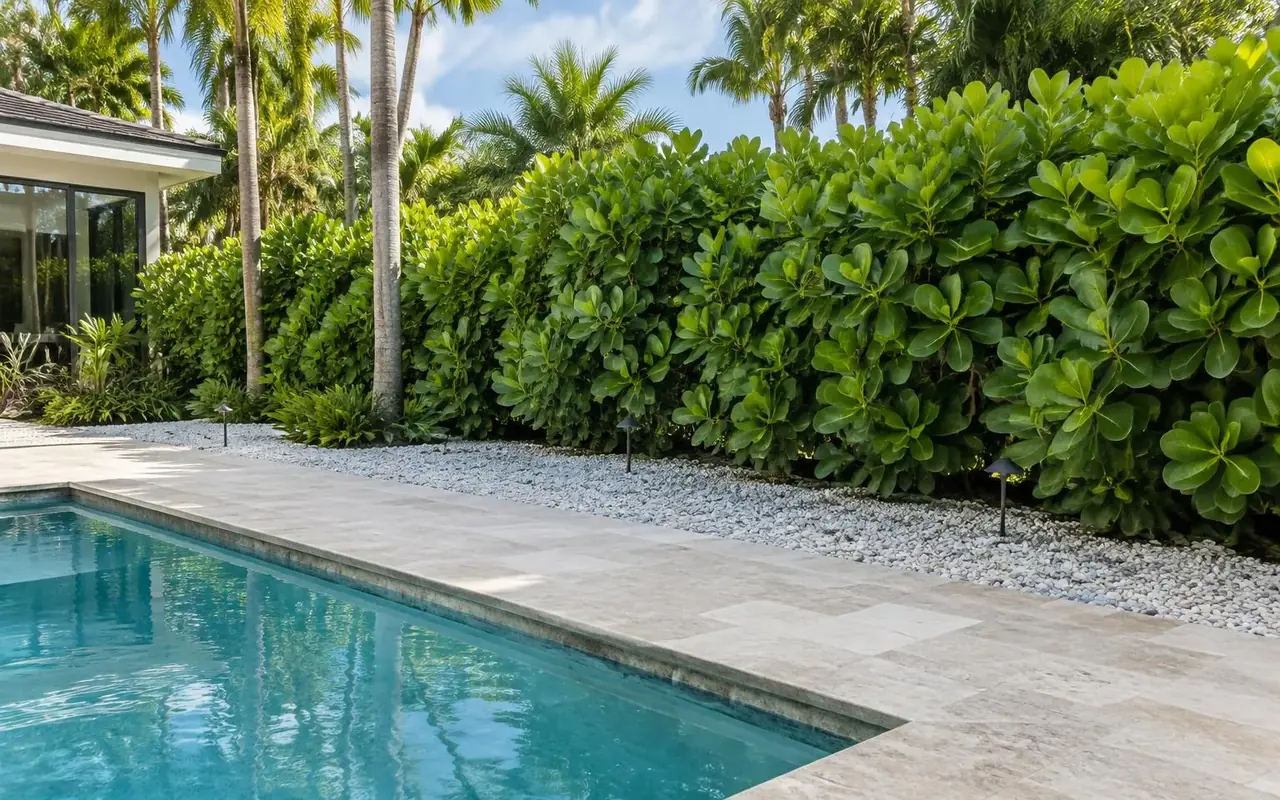
Are Clusia roots safe near structures?
No plant should be described as universally safe beside a pool, pipe, or foundation. Root behavior depends on the species, eventual plant size, soil, moisture, construction condition, and available growing space. A nursery container is a temporary package, not the footprint of a mature root system. Before selecting a hedge, establish how close its future maintained canopy and roots will be to each structure. UF/IFAS describes Clusia rosea as a substantial tree when unrestrained. A trimmed canopy does not prove that roots remain confined beneath it. The useful question is whether a particular layout gives a confirmed species enough room without creating conflicts that require repeated corrective work.
Locate pipes and services before excavation
Mark public utilities through the appropriate locating service before excavation, and determine whether private irrigation, pool equipment lines, drainage pipes, or septic components require a separate survey. Records may be incomplete, so do not rely entirely on where a previous owner remembers a pipe being installed. Keep an accessible plan showing the planting line and the services that must remain reachable. Discuss excavation methods with qualified personnel where infrastructure is close. Existing leaks and damaged joints deserve repair before a hedge makes access more difficult. A plant seller cannot certify the condition or location of underground construction simply from a photograph of the lawn. Make uncertainty a reason to investigate, not a reason to dig carefully and hope.
Pools need more than a root setback
Plan the hedge around pool maintenance, drainage, fencing, and equipment access as well as the shell itself. Leaves should not prevent inspection of safety barriers, and branches should not obstruct gates or routes used by service personnel. Consider where fallen foliage will collect and whether irrigation will create wet paving or discharge toward pool equipment. Ask a pool or structural professional to review a tight planting proposal where construction details are uncertain. Do not promise a universally safe number of feet from the water edge: the water edge may not identify the limits of buried construction. If the bed is too narrow for the plant's eventual scale, selecting another screen can be more practical than installing a hedge that must be kept in constant restraint.
Foundations, paving and maintenance access
Allow a usable gap for checking walls, drainage outlets, paving movement, and the base of the hedge. Planting against a structure can conceal moisture problems and make both pruning and repairs awkward. Compare the intended maintained width with actual available space rather than assuming a narrow initial plant stays narrow. Irrigation should serve the root zone without routinely soaking a building wall. Where cracking, settlement, or drainage trouble already exists, obtain an assessment before landscaping changes the site. A structural problem cannot be diagnosed as a root problem merely because roots are nearby. Keep photographs and installation records so any later concern can be evaluated against the original condition. Design for access that still works after the foliage becomes full.
Root barriers are a design decision, not a guarantee
Do not install a root barrier as a substitute for confirming species and choosing a suitable bed. A barrier changes the available soil space and may create maintenance or drainage considerations of its own. It requires a design that accounts for the plant, soil, construction, and intended service life. Discuss whether a barrier is appropriate with a qualified landscape or arboricultural professional before excavation. Avoid cutting established roots simply to force a hedge into a revised boundary; root removal can affect stability and plant health. If a mature planting conflicts with equipment, paving, or a building, investigate the whole site rather than applying a quick surface fix. Sometimes relocation, removal, or a different screening material is the more responsible option.
Identify the plant before choosing a plan
Confirm the botanical name on the nursery label and ask the supplier to identify the actual stock. Clusia rosea and the small-leaved plant commonly sold as Clusia guttifera are not interchangeable names. UF/IFAS documents C. rosea as a tree reaching about 25–30 feet tall and 15–25 feet wide, with moderate growth. Those dimensions describe an unrestrained tree, not a promise about a regularly clipped hedge. The same publication lists USDA zones 10B–11, full sun to dappled shade, and high drought and aerosol salt tolerance. Treat those tolerances as established-plant characteristics, not permission to neglect new transplants. Do not transfer its hardiness, mature dimensions, or other species-specific data automatically to C. guttifera. Keep the plant label and any written nursery identification with your landscape records.
Check the Florida site, not just the address
Florida is not one uniform growing environment. Compare your property's winter exposure, hours of direct light, drainage, and available bed width before selecting clusia. A warm coastal courtyard and an exposed inland lot can behave differently even within the same community. Check the bed after a substantial rain and look for standing water, soil washed against stems, and runoff arriving from adjacent paving. Locate irrigation pipes, underground services, septic components, easements, and access routes before excavation. Arrange utility marking through the appropriate service; private lines may require a separate locator. Ask a qualified landscape professional to assess tight boundaries, questionable drainage, or conflicts with structures. A hedge should fit its maintained size without blocking visibility, gates, equipment access, or required clearances. Where the site does not fit, changing the plant or layout is better than relying on constant corrective maintenance.
Support establishment without a rigid schedule
Inspect the original root ball and the surrounding soil separately; they can hold very different amounts of moisture. Check below the surface with a finger or suitable probe before deciding whether to water. Water when those checks show a need, applying it slowly enough to wet the root zone without sustained ponding. Rainfall, soil texture, wind, season, and nursery container size all change that decision. A timer setting is not evidence that roots received enough water. Keep mulch away from stems and avoid burying the root flare when adding soil or refreshing beds. Do not use fertilizer as a first response to stress. Review drainage, planting depth, roots, and irrigation first; obtain soil guidance and follow product labels and applicable local fertilizer restrictions if feeding is justified. Newly installed plants need observation even when established clusia nearby appears self-sufficient.
A practical checklist and reliable references
Before authorizing work, record the plant identification, measured bed dimensions, desired finished height, and any access restrictions. Photograph the whole planting and representative leaves so future changes are easier to compare. Walk the entire line rather than judging it from one attractive plant. After rain or irrigation, check low spots and a few root balls along both sunny and shaded stretches. Record what you actually observe before changing water, fertilizer, or pruning. Request a written scope that explains who handles installation corrections, debris removal, and follow-up inspections. If a problem persists or a major structural decision is involved, consult your county Extension office or an appropriately qualified landscape or tree professional.
Reference checks for this guide: UF/IFAS ST172, “Clusia rosea: Pitch Apple” (https://ask.ifas.ufl.edu/publication/ST172); Sarasota County Extension's species comparison (https://blogs.ifas.ufl.edu/sarasotaco/2024/02/07/flora-da-friendly-features-imposter-pitch-apple/); and Hillsborough County Extension's landscape overview (https://blogs.ifas.ufl.edu/hillsboroughco/2021/12/31/clusia-a-hugely-popular-landscape-plant/). Apply each source only to the plant and conditions it actually discusses.
Before you plant
- Confirm the botanical species and mature size.
- Check drainage, irrigation, utilities and property setbacks.
- Measure hedge length and discuss starting height.
- Review local restrictions and your written quote.
Check your USDA hardiness zone
Questions, answered
Plant care references
Clusia King Farms
Best Clusia in Florida
Get a farm-direct quote in minutes.
Step 1 of 3